
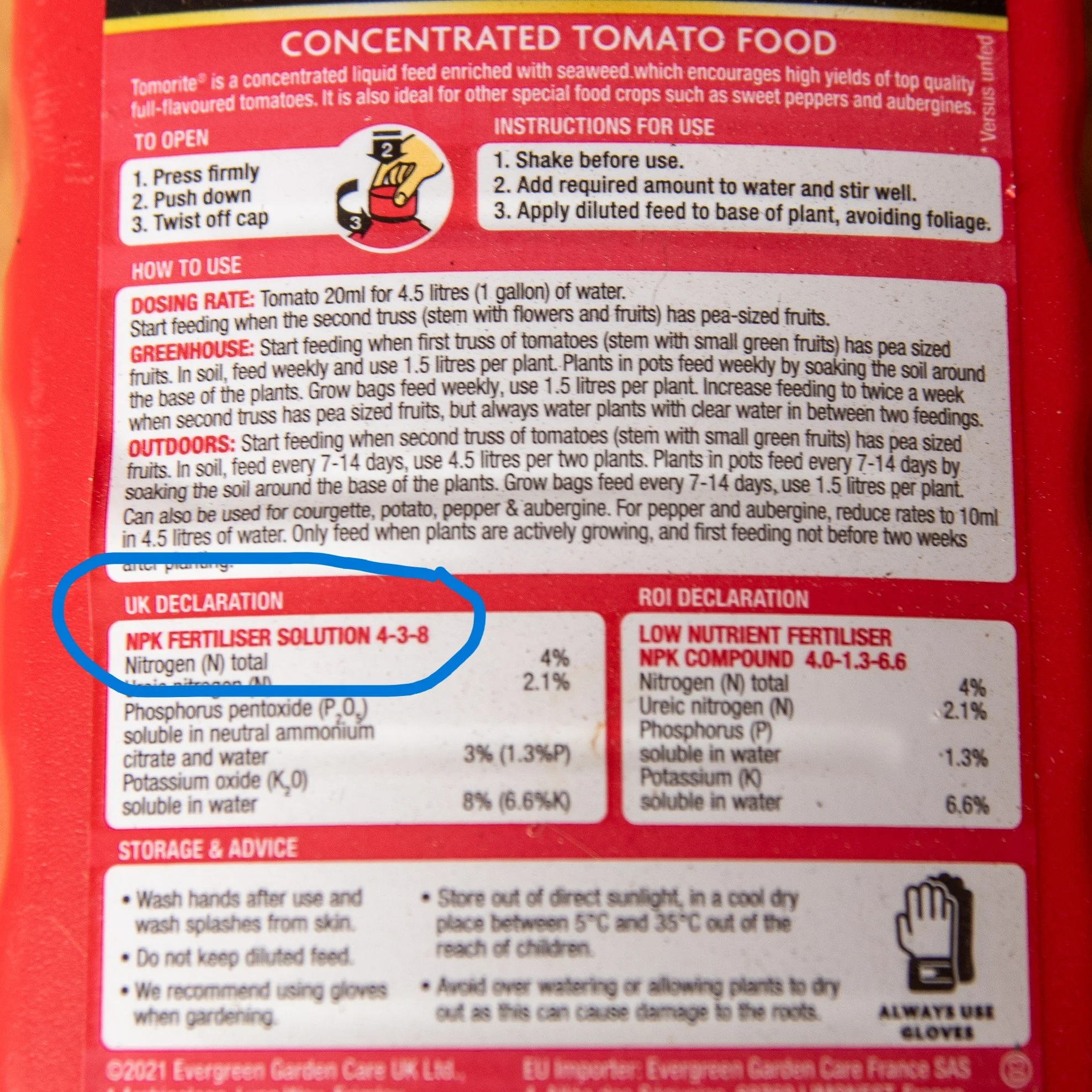
Walk into any garden centre and you will find shelves of bags and bottles covered in cheerful photographs of tomatoes, and somewhere on each one, in small print, three numbers separated by dashes. 7-7-7. 20-5-10. 4-3-8. They look like a combination lock, and for many gardeners they might as well be one.
Those numbers are the NPK ratio: the percentage by weight of nitrogen (N), phosphorus (P) and potassium (K) in the product. These are the three big nutrients plants need in the largest quantities, and each does a different job. Once you know which is which, the labels start to make sense, and you may find you don’t need any of them.
Nitrogen (N): the leaf maker
Nitrogen is all about green, leafy growth. It's a key part of chlorophyll, the pigment plants use to turn sunlight into food, and of the proteins that build new cells. A plant with plenty of nitrogen is a plant that grows quickly and looks lush.
You can spot a shortage fairly easily. Growth is slow and stunted, and leaves turn pale green and then yellow, usually starting with the older leaves at the bottom, because the plant robs them to feed the new growth at the top. Yellowing leaves have several possible causes, though, from waterlogging to iron deficiency, so don't reach for the bottle without a little detective work first.
Nitrogen is what you want for lawns, leafy vegetables like cabbages, kale and spinach, and hungry hedges getting back on their feet. It is also the nutrient most easily washed out of the soil by rain, which is why a spring feed is often recommended.
A word of caution: more is not better. Too much nitrogen gives you a mass of soft, sappy growth that aphids find irresistible and that is easily knocked back by frost. Plants overfed with nitrogen often put their energy into leaves at the expense of flowers and fruit. If you’re wondering why your magnificent tomato plant has no fruit an excess of nitrogen feed might be the answer.
Phosphorus (P): the root builder
Phosphorus is the plant's energy source. It is involved in transferring energy around the plant, and it is particularly important for strong root development, flowering and seed production. This is why it's the nutrient to think about when you're planting something new, whether that's a tree, a shrub, a rose or a bag of bulbs.
A shortage shows up as poor, stunted growth and, in some plants, a purplish tinge to the leaves, especially in cold weather when roots can't take up what's in the soil. That's worth knowing in a London spring, when a cold snap can cause a purple tint in perfectly well-fed plants. Check the weather before you check your fertiliser.
One thing to bear in mind, many UK garden soils, particularly long-cultivated ones, already contain plenty of it. Overuse is a real issue. Excess phosphorus is slow to leave the soil, can wash into streams and ponds and cause algal blooms, and can actually harm some native plants and Australian natives such as grevilleas and banksias, which have evolved to cope with very low-phosphate soils. This is what is happening with the River Wye where phosphorous from the large number of chicken farms is being washed into the water, causing green algal blloms, starving the water of oxygen. If you're planting wildflowers, in particular, a phosphorus-rich soil gives the grasses the upper hand, and the flowers lose out. A fertile soil is not always a good thing.
Bone meal is the traditional source of phosphorus, and is slow-release. It's handy at planting time, but you only need it if your soil is genuinely low in the stuff. And in London, do mix it in the soil - foxes find blood, fish and bone irresistible and will dig it up.
Potassium (K): the flower and fruit maker
Potassium, sometimes called potash, regulates how plants use water, helps them move sugars around, and is closely linked to flowering, fruiting and general toughness. A plant with enough potassium is better at coping with drought, frost and disease. If nitrogen is the growth nutrient, potassium is the quality nutrient.
The classic sign of a shortage is yellowing or browning along the leaf margins, as though the edges have been scorched, along with poor flowering and small or patchy fruit. Tomatoes, courgettes, apples, currants and roses all appreciate a good supply.
This is why tomato feed is high in potash: once the first flowers have set, you want the plant to turn its attention from leaves to fruit. The same goes for roses and for anything you're growing for flowers and fruit rather than foliage. Sulphate of potash is a useful straight fertiliser, and a home-made comfrey feed, which is rich in potassium, is a favourite of many organic gardeners.
One reassuring note: if you are gardening on London clay, you are unlikely to be short of potassium. Clay soils hold on to nutrients far better than light, sandy ones, and potash is generally plentiful. It's the sandy soils and containers that run short fastest.
Where does it all come from?
Well I definitely had to look this one up, it turns out the bag in your shed has usually had a more interesting life than you'd think. The three nutrients come from three very different places.
Nitrogen is the easy one to find and the hard one to use. Nearly four-fifths of the air is nitrogen gas, but plants can't take it in that form. Lightning converts a little of it (!), and the bacteria living in the root nodules of peas, beans and clover convert a good deal more, which is why legumes are such good friends to the vegetable patch. Rotting plant and animal matter then recycles it, so compost, manure and blood, fish and bone are all decent sources. Shop-bought nitrogen fertilisers are made by the Haber-Bosch process, which combines nitrogen from the air with hydrogen, usually from natural gas, to make ammonia. It's one of the most important industrial processes ever invented, and it uses a great deal of energy. Another really good reason to make your own compost.
Phosphorus comes out of the ground. It's mined as phosphate rock, mostly in Morocco, China, Russia and the US, and treated with acid to make it soluble. It's a finite resource, which is a good reason not to waste it. In the garden, bone meal, manure and compost are the organic sources, and the phosphorus in them started life in animals' bones and diets.
Potassium is mined too, from the beds of ancient dried-up seas. The word potash comes from "pot ash", the residue left when wood ash was boiled in iron pots. Commercial supplies come mainly from Canada, Russia and Belarus, and there's a mine at Boulby, on the North Yorkshire coast. Wood ash, seaweed and comfrey leaves are the organic alternatives, and clay soils release their own supply slowly as the particles weather, which is another reason London clay is rarely short of it. Those of you outside London with wood burners can use the old ashes, but less is definitely more.
The plant can't tell where its nutrients came from. It only takes up what's dissolved in the soil water. The difference is in how quickly they arrive, and in what else comes with them: organic sources release slowly and feed the soil life as well, while mineral fertilisers work fast but do nothing for soil structure. Improving soil health and avoiding harmful chemicals is why organic farmers and gardeners will not used manufactured fertilisers.
Reading the label
So how does this help in the garden centre? Match the numbers to the job. The order of the numbers is always the same, N first, then P and K is last.
High first number (for example 20-5-5): nitrogen-heavy, for lawns and leafy growth.
High last number (for example 4-3-8 or a tomato feed): potassium-heavy, for flowers and fruit.
Balanced (for example Growmore at 7-7-7): a general-purpose spring feed for beds and borders.
High middle number: phosphorus-heavy. Rarely needed in an established garden.
Peat-free compost often contains only enough nutrients for the first four to six weeks, so anything in a pot or container needs regular feeding after that. Plants in the ground, particularly in decent soil that has been mulched with compost or well-rotted manure every year, are often much better off than their owners think.
The things the label doesn't tell you
NPK is not the whole story. Plants also need calcium, magnesium, iron and a handful of trace elements, and none of it works if the soil structure is poor or the pH is wrong. An acid-loving camellia on chalky soil will go yellow whatever you feed it, because it can't take up the iron. And the best thing you can do for the soil's long-term fertility is not a bag at all, it's organic matter, which feeds the soil life that feeds the plants.
If you're not sure what your soil needs, a cheap test kit will give you a rough idea of pH and the main nutrients, and it beats guessing. Always follow the instructions on the packet, too: feeding is a case of little and often, not an emergency measure.
The short version
Nitrogen for leaves, phosphorus for roots, potassium for flowers and fruit. Check what the plant is actually telling you before you feed it, don't assume more is better, and remember that a good mulch does more for most gardens than a cupboard full of bottles.
A few quick questions
Can I use the same feed on everything?
A balanced feed is fine for general use in spring. But lawns, tomatoes and acid-loving plants all do better with something designed for them.
Are organic fertilisers better?
Generally, yes. Plants can't tell the difference at the molecular level. Organic feeds release more slowly and improve the soil as they go, but they're not automatically safer if you overdo them
When should I feed?
Mainly from spring to late summer, when plants are actively growing. Feeding late in the year can encourage soft growth that gets caught by the first frosts.
Do manufactured fertilisers have sell-by dates?
Usually, though in practice, as long as they are stored well, many can last several years.
Should I feed my tomatoes in pots?
Yes. The nutrients in peat free compost are used up quickly and a good tomato crop needs additional potassium, particularly as the plants start to flower. Homemade fertiliser from comfrey leaves will not be available until later in the summer. If you grow tomatoes in the ground, especially in London clay, additional fertiliser should not be needed and moisture is usually more available, resulting in larger plants with more fruit.