
Plant labels explained
When faced with a new plant, even I can find the label completely baffling. The small forest of symbols, abbreviations and numbers mean absolutely nothing to most people and, frankly, not always all that much to the person who wrote them either.
Plant labels are trying to do an impossible job: compress everything you need to know about a living thing onto a strip of plastic the size of a bookmark. Some do it well. Some are actively misleading. Nearly all of them assume you already know what they mean. So here's the decoding.
The name game
Every label should carry two names: the common name, which is recognisable but unreliable, and the botanical name, which is less familiar unless you did Latin at school, but does the actual work.
The trouble with common names is that they're regional, inconsistent and sometimes applied to several completely different plants. "Bluebell" means one thing in an English wood and something else entirely in Scotland. Ask for a "cranesbill" in three different nurseries and you may come away with three different genera. The botanical name — genus, species, and often a cultivar name in single quotes, like Salvia nemorosa 'Caradonna' — is the only way to be sure you're getting what you think you're getting. It's not showing off, it's just precision.
The cultivar name matters more than people assume. Two salvias from the same species can behave completely differently in the garden — one compact and floriferous, another leggy and sparse. If a label just says "salvia" with no cultivar, be a little suspicious. That's the equivalent of a car advert that just says "car."
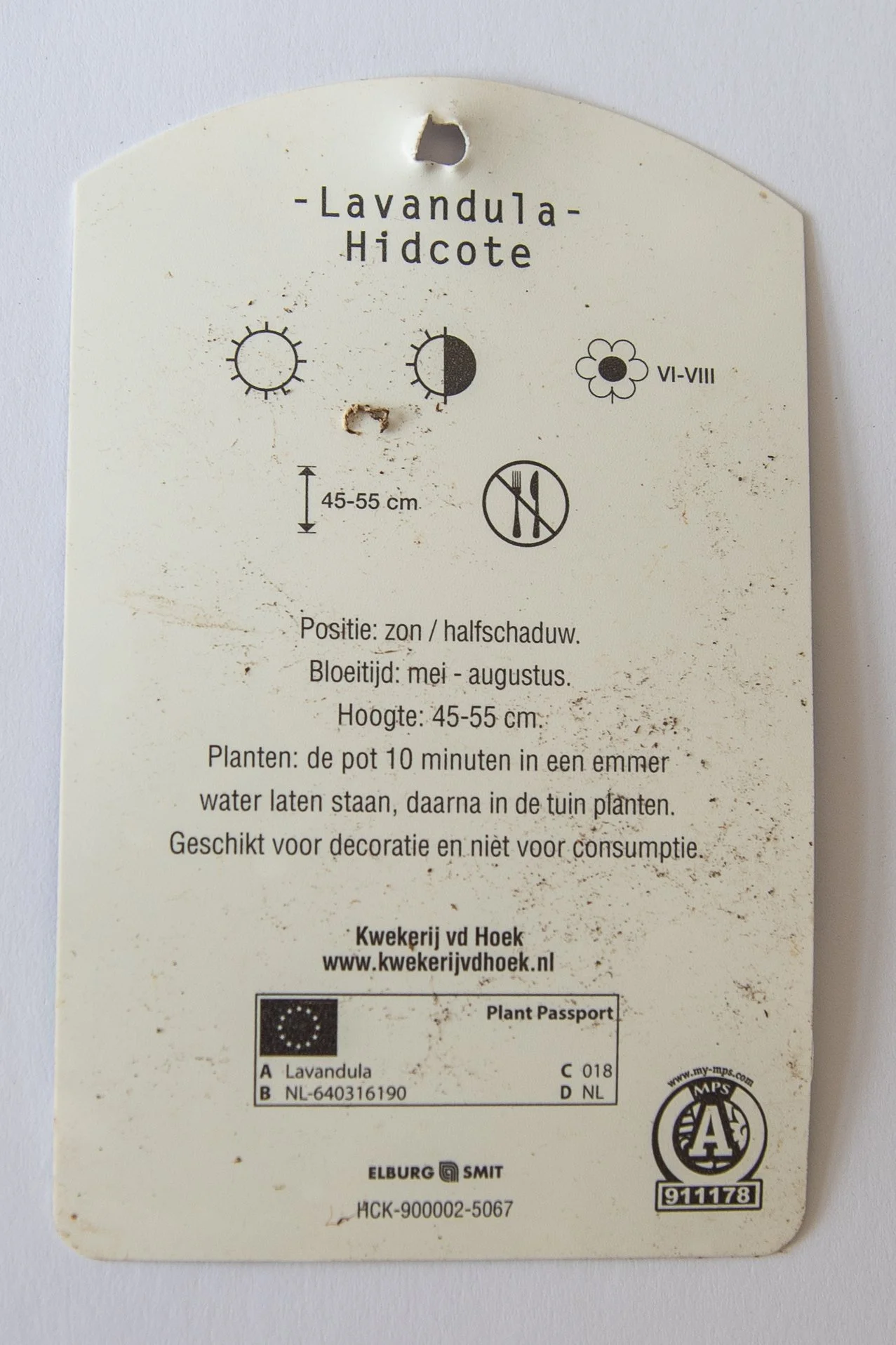
The name isn’t quite accurate, it should be Lavandula angustifolia ‘Hidcote’. It should have a trophy symbol showing it has an AGM but this plant was clearly grown in the Netherlands not the UK. It says plant in full sun or partial sun but we all know that lavenders prefer full sun and free-draining soil. It says don’t eat it but you can eat the dried flowers of some lavenders - Lavandula angustifolia ‘Hidcote’ and Lavandula a. ‘Munstead’ - ever had lavender icecream or lavender sugar? Is this label useful? Not very!
The little symbols
This is where most people's eyes glaze over, understandably, because the symbols vary between suppliers and are rarely explained on the label itself. If there’s any text it’s as likely to be in Dutch or German as in English.
Sun and shade. A plain sun symbol means full sun. A half-shaded sun means partial shade — some sun, some shelter. A symbol that's mostly shaded means, unsurprisingly, shade. As I've said more than once on this blog, London gardens are notoriously shady places, so this symbol is one of the most useful things on the whole label, and one of the most commonly ignored. But what exactly does full sun and half sun really mean?
Full sun - the plant needs at least six hours of full sun on the leaves, not filtered or dappled light, but full on and usually including the most intense sun in the middle of the day. If you choose a plant that needs this and plant it somewhere less than optimal it probably won’t die but it won’t produce the amount of flowers or fruit you expect and the plants may well become leggy as they reach for the sun. Because they are growing in sub-optimal conditions they are more susceptible to pests and diseases. Most fruit, vegetables need full sun, and quite often more than six hours a day.
Partial sun - plants need between four and six hours of sun a day, preferably in the cooler parts of the day, usually the morning. Some may cope with longer spells of dappled light. Hydrangeas and hostas would be happy in partial sun.
Partial shade - similar to partial sun but plants would prefer the lower end of the amount of sunlight - only three to four hours with definite protection from the most intense heat and light. This would suit many woodland edge plants like azaleas, digitalis and Japanese acers.
Full shade - this is for plants that need less than three hours of full sun a day and definitely no intense or afternoon sunlight. They can also cope with no direct sun at all. One thing you have to look out for here is that often these plants require moist soil. So if your full shade is in the shadow of a tall brick wall it’s likely the soil will be very dry. Make sure your shade tolerant plant will also cope with dry soil - these plants can be few and far between… Moisture-loving plants for full shade include moss, most ferns and Lily of the Valley, For dry shade, consider liriope and geranium macrorrhizum. Even these would need some moisture to get going. If in doubt, ask.
Water drop. Usually indicates moisture needs — one drop for well-drained or dry soil, more drops for moisture-retentive or wet ground. Worth taking seriously if you're gardening on London clay, where "well-drained" in May can mean "waterlogged" by January.
Hardiness rating (H1a to H7). This is the RHS scale and it's genuinely useful, provided you know what it means. H7 is fully hardy anywhere in the UK, hardy down to -20°C and below. H4 is hardy through an average UK winter, down to about -10°C. H1a to H1c means you need to cover plants that need protection, right down to H1a, which basically means "keep it on a windowsill and hope." The scale was updated a few years ago precisely because the old, vaguer system wasn't coping with how much our winters have changed — which, if you read my post on climate change, will come as no surprise at all. It’s worth noting that a rating is a guide to an average winter, not a guarantee against a genuinely hard one.
The trophy symbol. This is the RHS Award of Garden Merit, or AGM — a small gold trophy or the letters "AGM" tucked into a corner. It means the plant has been trialled by the RHS and judged to perform reliably well in UK gardens: good health, good garden value, nothing prone to collapsing in a strong wind or sulking the moment it's looked at. It's one of the few symbols on a label I'd genuinely trust over my own first impression of a plant.
You should note the century-old RHS Award of Garden Merit is to become the RHS Recommended: Award of Garden Merit, making plant choices clearer and easier for gardeners. I think you will find the trophy sign on plant labels for many years to come.
Size matters, and this is where labels can be most misleading.
Height and spread figures are meant to tell you how big the plant will get at maturity, which sounds simple and is, in practice, one of the least reliable things on the whole label. Partly this is because "maturity" is undefined — two years, ten, fifty… — and partly because growth depends enormously on your soil, aspect and how ruthlessly you prune. I've seen two identical cultivars, planted a few streets apart, one in Wimbledon Village and one in the Wimbledon town, end up a third different in size purely because the former is on lovely loam and the latter is on heavy clay.
Treat the figures as a rough guide, particularly for trees and shrubs, and always plan spacing on the eventual size rather than the sweet little specimen currently sitting in its two-litre pot. This is the single most common mistake I see in gardens I'm asked to redesign — everything planted at the "just right" distance for year one, and a solid wall of shrub by year five.
Plant passport - is used to track the movement of plants and plant products in and out of the country, ensuring they are free from pests and diseases. It guarantees traceability throughout the supply chain and is mandatory for trade between professional growers and suppliers. Should you care about this? Maybe not in general unless you are particularly interested in supporting British growers or you are looking for British native wildflowers. The provenance of so called “British natives” is likely to be pretty dubious if the plants (or seed) come from outside the UK.
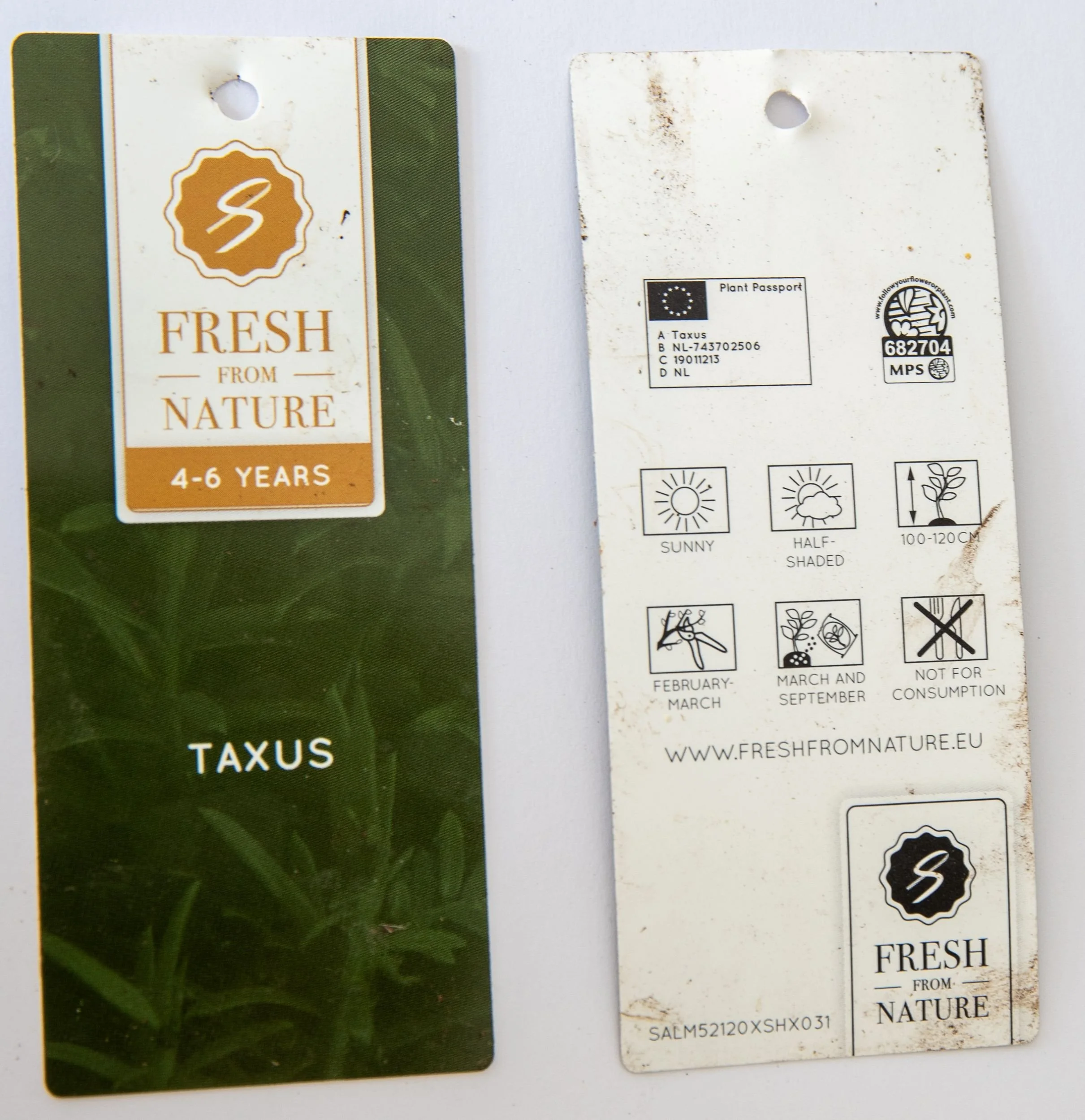
Another plant from the Netherlands - the Dutch plant industry is huge. The full name here should read Taxus baccata, meaning English Yew. Another plant that has an AGM but you wouldn’t know it. I’m not sure what 4-6 years means. Is it the age of the plant or the years to maturity? Yews can reach 10m high given enough time and are quicker growing than you’d expect so I think the 100-120cm is a bit misleading. You would need to prune it every year to maintain that. You definitely shouldn’t eat yew so at least that is right. And yew is a really useful plant for growing in shade, not just sun and partial shade as shown here. The time to feed is handy but the RHS recommends pruning in late summer or early autumn…
What the label doesn't tell you
No label, however good, replaces knowing your own garden. It won't tell you that the sunny spot it wants is also the one battered by wind between houses, or that your "well-drained" bed sits in a frost pocket every April. This is really just the old principle again — right plant, right place — and a label can only ever get you halfway there. The rest is knowing the actual patch of ground you're planting into.
It's also worth glancing for a small warning triangle or "toxic if ingested" note if you have children, pets, or a dog that eats absolutely everything with great enthusiasm. Foxgloves, daffodil bulbs and yew* are all garden regulars that deserve a moment's thought if you've got a puppy who chews everything. And lilies, autumn crocuses, hyacinths and daffodils are poisonous for cats*.
(*These are not exhaustive lists of plants that are poisonous to pets).
The short version
Read the botanical name properly, don't skip the cultivar. Take the sun, shade and moisture symbols seriously — they're the most reliably useful thing on the label. Treat the hardiness rating as a guide to an average winter, not a promise. And treat height, spread and "maturity" with a healthy pinch of scepticism, because gardens, like people, rarely stick to the schedule they were given.
A few quick questions
What does H4 actually mean in practice?
It means the plant should survive a typical UK winter unprotected, down to around -10°C. It doesn't guarantee survival through an unusually hard winter, or in an exposed, frost-pocket site.
What's the difference between the trophy symbol and a star rating some labels use?
The trophy (or the letters AGM) is the RHS Award of Garden Merit — an independent trial-based endorsement. Star ratings you sometimes see are usually a supplier's own marketing, not an independent assessment, so it's worth knowing which one you're looking at.
Why do two labels for the same plant sometimes give different heights?
Different growers, different trial conditions, and different assumptions about how long "maturity" takes. Soil, climate and pruning all affect the final size more than the label can account for.
Are plant labels always accurate?
Mostly reliable on naming and hardiness, less reliable on eventual size, and occasionally just wrong — mislabelling happens more often than nurseries would like to admit. If a plant looks nothing like its label once it flowers, you're not imagining it.
In the course of writing this I did not come across a single plant label I thought completely accurate and/or useful. If you are looking at a plant you are not familiar with then check a reputable online resource like the RHS or Gardener’s World Magazine.